
 # The Art of the Makeup Touch-Up: Why Your Matte Look Fades and How to Fix It
You spent twenty minutes perfecting your matte makeup this morning, but by noon, it's vanished. The shine is back, your foundation appears patchy, and you're left wondering what went wrong.
Spoiler alert: you didn't do anything wrong.
The reality is that matte makeup doesn't stay that way forever. Your skin naturally produces oil-about 1.5 grams every 12 hours on average. This oil mixes with your foundation, breaks down pigments, and leads to that frustrating "melting" effect. It's biology, not a product of poor technique.
The good news? You can manage it. The key is knowing when to blot, when to powder, and when to start fresh. Many people instinctively reach for powder at the first sign of shine, but that's often a misstep. Powder adds layers. Layers lead to caking. And caking cracks.
This guide will dive into the science behind makeup breakdown, the tools that actually work, and the precise steps to refresh your look without ruining your hard work. By the end, you'll be equipped to keep your matte makeup looking flawless from your morning commute to your evening plans.
Let's first explore why this happens in the first place.
## Why Your Matte Makeup Breaks Down During the Day
Think of your face as a canvas. You've created a beautiful, matte masterpiece. Now picture someone gradually dripping water onto that canvas. That's essentially what your skin's natural oils do to your makeup.
Your sebaceous glands produce sebum-an oily substance that helps keep your skin hydrated. On a typical day, those glands release about 1 to 2 milligrams of oil per 10 square centimeters of skin every 3 hours. In your T-zone (forehead, nose, chin), that number can double.
Here's how it typically unfolds:
**Hour 1-2:** Your makeup looks impeccable. The matte finish is holding strong. You might even forget you're wearing any makeup at all.
**Hour 3-4:** Oil starts seeping through your foundation, resulting in a slight sheen on your forehead and a shiny nose. This is a pivotal moment-how you respond next can shape the rest of your day.
**Hour 5-6:** Oil has mixed with your foundation, causing pigments to separate. You may notice patchiness around your nose and between your eyebrows, and your concealer begins to crease.
**Hour 7+:** The full breakdown occurs. Your makeup appears uneven, with shine creeping across your cheeks and chin. You might even see tiny beads of oil resting atop your foundation.
This timeline can vary depending on your skin type, environment, and the products you use. Someone with oily skin might hit hour 3 in just 90 minutes, while someone with dry skin might last 6 hours before seeing any shine.
The real issue isn't the oil itself-it's how we react to it. Most people reach for powder and press it onto their skin. That may work for about 30 minutes. Then the oil seeps through the powder, and you're back where you started-this time with an added thick, cakey layer.
A better approach? Remove the oil first and then decide if you need powder.
## Blotting Paper vs. Setting Powder: Which is Better?
This is the burning question in the matte makeup world, and the answer really hinges on your goals.
**Blotting paper** simply lifts the oil. It doesn't add anything to your skin or alter your makeup's texture; it just removes excess oil from the surface.
**Setting powder**, on the other hand, absorbs oil while adding a matte finish. But don't forget, it also adds product. And every time you layer on product, you risk buildup.
Here's a side-by-side comparison:
| Factor | Blotting Paper | Setting Powder |
|--------|----------------|----------------|
| What it does | Removes oil | Absorbs oil + adds coverage |
| Texture change | None | Can become cakey |
| Best for | Light shine | Heavy shine + touch-ups |
| Reapplication limit | Unlimited | 2-3 times max |
| Mess | None | Can be messy |
| Time needed | 10 seconds | 30-60 seconds |
**When to choose blotting paper:** You notice a light sheen, but your overall makeup still looks great. Blotting paper is ideal for those mid-morning or mid-afternoon moments when your skin starts to appear dewy but not completely oily. You can use it every couple of hours without any downsides.
**When to choose setting powder:** If you've already blotted but the shine returns quickly or your makeup appears patchy, then it's time to reach for the powder. Just limit your use to once or twice a day. Beyond that, you'll be adding layers that could crack.
**The hybrid approach:** Always start with blotting paper. Assess your makeup afterward. If it looks fresh, stop there. If shine or unevenness lingers, lightly dust with powder. This two-step method will keep your matte makeup looking natural rather than caked on.
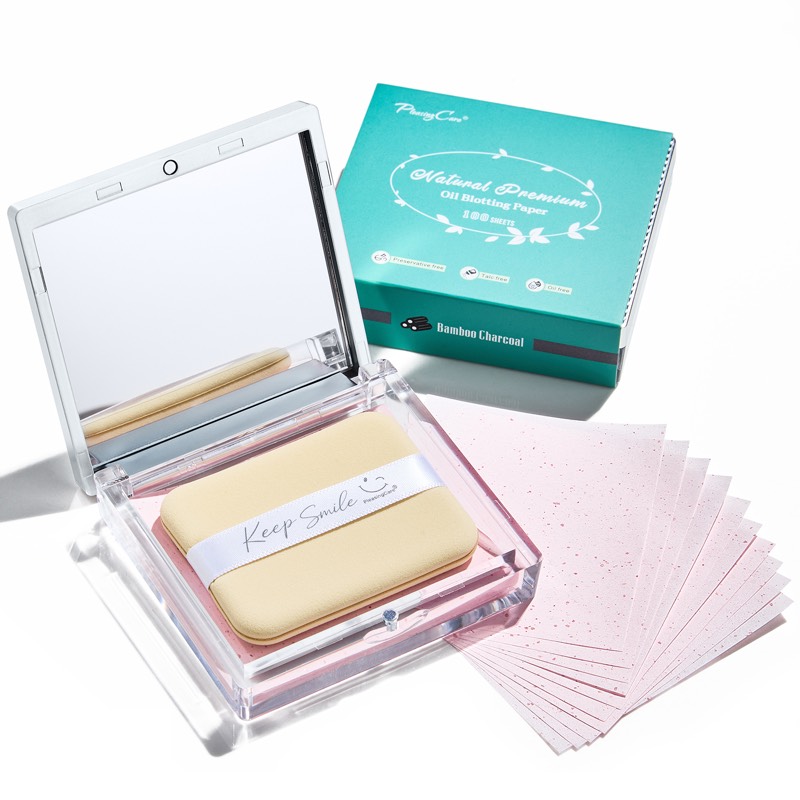
Also, keep in mind that not all blotting papers are created equal. Thin, flimsy sheets can tear or leave fibers behind. Look for durable options made from natural materials like bamboo charcoal or green tea fibers. Our [charcoal blotting paper](/charcoal/) is designed to absorb three times more oil than standard papers without disturbing your makeup, while our [green tea blotting paper](/green-tea/) gives you a subtle antioxidant boost while you blot.
## The Right Way to Blot Without Ruining Your Makeup
Here's where many people go astray: they press, rub, or swipe. That's not blotting-that's smudging.
Blotting is a delicate art. When done correctly, it removes oil without disturbing any pigments. If done incorrectly, you risk lifting foundation, smearing concealer, and creating more chaos than you resolve.
**Step 1: Wait for the right moment.** Don't rush to blot at the first hint of shine. Wait until you see a visible layer of oil-not just a sheen, but actual oil on top of your makeup. This usually takes about 3-4 hours. Blotting too soon removes the natural moisture that helps your makeup stay flexible; waiting too long allows the oil to break down your foundation.
**Step 2: Use the right pressure.** Take your blotting paper and gently press it onto the shiny area. Hold for 3-5 seconds. No rubbing or sliding-just press and hold. The oil will transfer to the paper naturally. You should see a visible oil spot on the paper when you lift it.
**Step 3: Use separate sheets for different zones.** Use one sheet for your forehead, another for your nose, and a third for your chin. This prevents transferring oil from one area to another. Sure, you'll use more sheets, but your makeup will look better.
**Step 4: Check your work.** After blotting, examine your face in natural light. If you still see shine, press another sheet onto the same area. If your makeup appears matte and even, you're done.
**Step 5: Only then, consider powder.** If your makeup looks patchy after blotting, it's time to apply a very light dusting of powder. Use a fluffy brush and tap off the excess before applying in circular motions, focusing on the areas you blotted.
**Real-life scenario:** It's 2 PM and you glance in your compact mirror, noticing shine on your nose and forehead. You pull out your blotting paper and press it on your nose for 4 seconds. You lift it up and see an oil spot. Next, you press a fresh sheet on your forehead. Another oil spot. You check your face-shine is gone and your foundation looks as good as it did at 9 AM. You put the blotting paper away and keep going. No powder needed.
That's the ideal workflow: simple, effective, and non-destructive.
## Fixing Oily Eyelids Without Disturbing Eye Makeup
Eyelids pose a unique challenge. They're the oiliest part of your face, producing about 20% more oil per square centimeter than your T-zone. Plus, they're home to your most delicate makeup: eyeshadow, eyeliner, and mascara.
One wrong move, and you could end up with raccoon eyes.
**The problem with powder on eyelids:** Powder can settle into creases, make eyeshadow appear cakey, and if you have hooded eyes, it can emphasize the fold line. Plus, powder near your eyes can get into your lashes, leading to that dusty, white-tipped look.
**The blotting paper solution:** Blotting paper is far gentler for eyelids. Here's how to do it right:
1. **Fold the paper into a small triangle.** This gives you a precise edge that fits the curve of your eyelid.
2. **Close your eye.** Press the folded edge along your crease line and hold for 3 seconds.
3. **Open your eye.** Gently press the flat part of the paper across your entire eyelid. Don't rub.
4. **Check your lash line.** If you notice oil at the base of your lashes, use the corner of the paper to dab it away.
**The one exception:** If your eyeshadow has completely creased or faded, blotting won't be enough. In that case, you'll need to remove and reapply. But for simple oil control, blotting paper is your best ally.
**Real-life scenario:** You're at a dinner party and feel your eyelids becoming greasy. You excuse yourself to the restroom, pull out your blotting paper, fold it into a triangle, and press it along your crease. A quick check in the mirror reveals your eyeshadow still looks fresh-no creasing, no smudging. You're back at the table in just 30 seconds.
Pro tip: Keep a small pack of blotting paper in your bag specifically for eye touch-ups. Our [puff case](/puff-case/) is perfect for this-it's compact, protective, and fits seamlessly in any clutch or pocket.
## When to Blot and When to Reapply: A Decision Guide
Not every makeup issue can be resolved with a simple blot. Sometimes you need to start afresh. The key is knowing when to do which.
**Blot when:**
- You see shine, but your makeup looks even
- Your foundation hasn't moved or separated
- You can still see your makeup clearly through the oil
- It's been less than 6 hours since you applied your makeup
- You've only blotted once or twice today
**Reapply when:**
- Your makeup looks patchy or uneven
- You can see bare skin peeking through your foundation
- Your concealer has completely faded under your eyes
- It's been over 8 hours since you applied your makeup
- You've already blotted and powdered, but shine returns within 30 minutes
**The 3-before-3 rule:** If you find yourself needing to touch up more than three times in a day, or if you've applied powder more than three times, it's time for a full removal and reapplication. Your makeup has reached its limit-adding more product will only worsen the situation.
**How to reapply without starting from scratch:**
1. **Blot first.** Remove as much oil as you can.
2. **Use a makeup setting spray.** Lightly mist your face. This helps dissolve the top layer of product without removing it.
3. **Wait 30 seconds.** Let the spray settle.
4. **Blot again.** This gets rid of the dissolved product and oil.
5. **Apply a thin layer of foundation or concealer only where needed.** Don't cover your whole face.
6. **Set with a light dusting of powder.**
This "partial reapplication" method takes about 2 minutes and can extend your makeup's life by another 4-6 hours.
**Real-life scenario:** It's 5 PM, and after a long day, your makeup looks decent from a distance, but up close, you notice patchiness around your nose and faded under-eye concealer. You blot first, then spray setting mist. After waiting, you blot again, apply a bit of concealer under your eyes and on your nose, and finish with a dusting of powder. You check the mirror-your makeup looks fresh again, and you're ready for your evening plans.
## Conclusion
Your matte makeup doesn't have to fall victim to midday shine. The secret isn't piling on more powder or creating thicker layers; it's mastering the art of oil removal without disturbing your hard work.
Blotting paper is the unsung hero of the makeup touch-up routine. It absorbs oil, preserves your finish, adds no bulk, and works like a charm every single time.
So next time you spot that afternoon shine, skip the powder and reach for blotting paper instead. Press for 3-5 seconds, check your work, and then determine if you need more.
Your makeup will thank you, and so will your skin.
Ready to elevate your touch-up game? Our [charcoal blotting paper](/charcoal/) is designed specifically for matte makeup enthusiasts. It absorbs three times more oil than standard papers, won't tear or leave fibers behind, and fits perfectly in any bag. Give it a try and experience the difference a good blot can make!
## Frequently Asked Questions
### How to touch up makeup without powder?
Press a blotting paper gently on oily areas for 3-5 seconds. This removes excess oil without disturbing your foundation. Then, if needed, apply concealer only where coverage has faded.
### Blotting paper vs setting powder for makeup?
Blotting paper is better for removing oil without adding layers that can look cakey. Setting powder is better for locking makeup in place in dry environments. Use blotting paper during the day, powder at night or in dry AC.
### Should I blot before or after reapplying makeup?
Always blot BEFORE reapplying makeup. Removing oil first gives your makeup something clean to adhere to. If you apply makeup over oil, it will slip and separate faster.
### How to fix oily eyelids without ruining eye makeup?
Hold a small piece of blotting paper against closed eyelids for 3-5 seconds. Don't press hard or move laterally. This absorbs oil from your lids without disturbing eyeshadow or liner.
### Best blotting paper for makeup wearers?
Look for thin, lint-free sheets that absorb quickly. Bamboo charcoal blotting paper works well because it absorbs oil efficiently without leaving residue that can disturb foundation.
# The Art of the Makeup Touch-Up: Why Your Matte Look Fades and How to Fix It
You spent twenty minutes perfecting your matte makeup this morning, but by noon, it's vanished. The shine is back, your foundation appears patchy, and you're left wondering what went wrong.
Spoiler alert: you didn't do anything wrong.
The reality is that matte makeup doesn't stay that way forever. Your skin naturally produces oil-about 1.5 grams every 12 hours on average. This oil mixes with your foundation, breaks down pigments, and leads to that frustrating "melting" effect. It's biology, not a product of poor technique.
The good news? You can manage it. The key is knowing when to blot, when to powder, and when to start fresh. Many people instinctively reach for powder at the first sign of shine, but that's often a misstep. Powder adds layers. Layers lead to caking. And caking cracks.
This guide will dive into the science behind makeup breakdown, the tools that actually work, and the precise steps to refresh your look without ruining your hard work. By the end, you'll be equipped to keep your matte makeup looking flawless from your morning commute to your evening plans.
Let's first explore why this happens in the first place.
## Why Your Matte Makeup Breaks Down During the Day
Think of your face as a canvas. You've created a beautiful, matte masterpiece. Now picture someone gradually dripping water onto that canvas. That's essentially what your skin's natural oils do to your makeup.
Your sebaceous glands produce sebum-an oily substance that helps keep your skin hydrated. On a typical day, those glands release about 1 to 2 milligrams of oil per 10 square centimeters of skin every 3 hours. In your T-zone (forehead, nose, chin), that number can double.
Here's how it typically unfolds:
**Hour 1-2:** Your makeup looks impeccable. The matte finish is holding strong. You might even forget you're wearing any makeup at all.
**Hour 3-4:** Oil starts seeping through your foundation, resulting in a slight sheen on your forehead and a shiny nose. This is a pivotal moment-how you respond next can shape the rest of your day.
**Hour 5-6:** Oil has mixed with your foundation, causing pigments to separate. You may notice patchiness around your nose and between your eyebrows, and your concealer begins to crease.
**Hour 7+:** The full breakdown occurs. Your makeup appears uneven, with shine creeping across your cheeks and chin. You might even see tiny beads of oil resting atop your foundation.
This timeline can vary depending on your skin type, environment, and the products you use. Someone with oily skin might hit hour 3 in just 90 minutes, while someone with dry skin might last 6 hours before seeing any shine.
The real issue isn't the oil itself-it's how we react to it. Most people reach for powder and press it onto their skin. That may work for about 30 minutes. Then the oil seeps through the powder, and you're back where you started-this time with an added thick, cakey layer.
A better approach? Remove the oil first and then decide if you need powder.
## Blotting Paper vs. Setting Powder: Which is Better?
This is the burning question in the matte makeup world, and the answer really hinges on your goals.
**Blotting paper** simply lifts the oil. It doesn't add anything to your skin or alter your makeup's texture; it just removes excess oil from the surface.
**Setting powder**, on the other hand, absorbs oil while adding a matte finish. But don't forget, it also adds product. And every time you layer on product, you risk buildup.
Here's a side-by-side comparison:
| Factor | Blotting Paper | Setting Powder |
|--------|----------------|----------------|
| What it does | Removes oil | Absorbs oil + adds coverage |
| Texture change | None | Can become cakey |
| Best for | Light shine | Heavy shine + touch-ups |
| Reapplication limit | Unlimited | 2-3 times max |
| Mess | None | Can be messy |
| Time needed | 10 seconds | 30-60 seconds |
**When to choose blotting paper:** You notice a light sheen, but your overall makeup still looks great. Blotting paper is ideal for those mid-morning or mid-afternoon moments when your skin starts to appear dewy but not completely oily. You can use it every couple of hours without any downsides.
**When to choose setting powder:** If you've already blotted but the shine returns quickly or your makeup appears patchy, then it's time to reach for the powder. Just limit your use to once or twice a day. Beyond that, you'll be adding layers that could crack.
**The hybrid approach:** Always start with blotting paper. Assess your makeup afterward. If it looks fresh, stop there. If shine or unevenness lingers, lightly dust with powder. This two-step method will keep your matte makeup looking natural rather than caked on.
Also, keep in mind that not all blotting papers are created equal. Thin, flimsy sheets can tear or leave fibers behind. Look for durable options made from natural materials like bamboo charcoal or green tea fibers. Our [charcoal blotting paper](/charcoal/) is designed to absorb three times more oil than standard papers without disturbing your makeup, while our [green tea blotting paper](/green-tea/) gives you a subtle antioxidant boost while you blot.
## The Right Way to Blot Without Ruining Your Makeup
Here's where many people go astray: they press, rub, or swipe. That's not blotting-that's smudging.
Blotting is a delicate art. When done correctly, it removes oil without disturbing any pigments. If done incorrectly, you risk lifting foundation, smearing concealer, and creating more chaos than you resolve.
**Step 1: Wait for the right moment.** Don't rush to blot at the first hint of shine. Wait until you see a visible layer of oil-not just a sheen, but actual oil on top of your makeup. This usually takes about 3-4 hours. Blotting too soon removes the natural moisture that helps your makeup stay flexible; waiting too long allows the oil to break down your foundation.
**Step 2: Use the right pressure.** Take your blotting paper and gently press it onto the shiny area. Hold for 3-5 seconds. No rubbing or sliding-just press and hold. The oil will transfer to the paper naturally. You should see a visible oil spot on the paper when you lift it.
**Step 3: Use separate sheets for different zones.** Use one sheet for your forehead, another for your nose, and a third for your chin. This prevents transferring oil from one area to another. Sure, you'll use more sheets, but your makeup will look better.
**Step 4: Check your work.** After blotting, examine your face in natural light. If you still see shine, press another sheet onto the same area. If your makeup appears matte and even, you're done.
**Step 5: Only then, consider powder.** If your makeup looks patchy after blotting, it's time to apply a very light dusting of powder. Use a fluffy brush and tap off the excess before applying in circular motions, focusing on the areas you blotted.
**Real-life scenario:** It's 2 PM and you glance in your compact mirror, noticing shine on your nose and forehead. You pull out your blotting paper and press it on your nose for 4 seconds. You lift it up and see an oil spot. Next, you press a fresh sheet on your forehead. Another oil spot. You check your face-shine is gone and your foundation looks as good as it did at 9 AM. You put the blotting paper away and keep going. No powder needed.
That's the ideal workflow: simple, effective, and non-destructive.
## Fixing Oily Eyelids Without Disturbing Eye Makeup
Eyelids pose a unique challenge. They're the oiliest part of your face, producing about 20% more oil per square centimeter than your T-zone. Plus, they're home to your most delicate makeup: eyeshadow, eyeliner, and mascara.
One wrong move, and you could end up with raccoon eyes.
**The problem with powder on eyelids:** Powder can settle into creases, make eyeshadow appear cakey, and if you have hooded eyes, it can emphasize the fold line. Plus, powder near your eyes can get into your lashes, leading to that dusty, white-tipped look.
**The blotting paper solution:** Blotting paper is far gentler for eyelids. Here's how to do it right:
1. **Fold the paper into a small triangle.** This gives you a precise edge that fits the curve of your eyelid.
2. **Close your eye.** Press the folded edge along your crease line and hold for 3 seconds.
3. **Open your eye.** Gently press the flat part of the paper across your entire eyelid. Don't rub.
4. **Check your lash line.** If you notice oil at the base of your lashes, use the corner of the paper to dab it away.
**The one exception:** If your eyeshadow has completely creased or faded, blotting won't be enough. In that case, you'll need to remove and reapply. But for simple oil control, blotting paper is your best ally.
**Real-life scenario:** You're at a dinner party and feel your eyelids becoming greasy. You excuse yourself to the restroom, pull out your blotting paper, fold it into a triangle, and press it along your crease. A quick check in the mirror reveals your eyeshadow still looks fresh-no creasing, no smudging. You're back at the table in just 30 seconds.
Pro tip: Keep a small pack of blotting paper in your bag specifically for eye touch-ups. Our [puff case](/puff-case/) is perfect for this-it's compact, protective, and fits seamlessly in any clutch or pocket.
## When to Blot and When to Reapply: A Decision Guide
Not every makeup issue can be resolved with a simple blot. Sometimes you need to start afresh. The key is knowing when to do which.
**Blot when:**
- You see shine, but your makeup looks even
- Your foundation hasn't moved or separated
- You can still see your makeup clearly through the oil
- It's been less than 6 hours since you applied your makeup
- You've only blotted once or twice today
**Reapply when:**
- Your makeup looks patchy or uneven
- You can see bare skin peeking through your foundation
- Your concealer has completely faded under your eyes
- It's been over 8 hours since you applied your makeup
- You've already blotted and powdered, but shine returns within 30 minutes
**The 3-before-3 rule:** If you find yourself needing to touch up more than three times in a day, or if you've applied powder more than three times, it's time for a full removal and reapplication. Your makeup has reached its limit-adding more product will only worsen the situation.
**How to reapply without starting from scratch:**
1. **Blot first.** Remove as much oil as you can.
2. **Use a makeup setting spray.** Lightly mist your face. This helps dissolve the top layer of product without removing it.
3. **Wait 30 seconds.** Let the spray settle.
4. **Blot again.** This gets rid of the dissolved product and oil.
5. **Apply a thin layer of foundation or concealer only where needed.** Don't cover your whole face.
6. **Set with a light dusting of powder.**
This "partial reapplication" method takes about 2 minutes and can extend your makeup's life by another 4-6 hours.
**Real-life scenario:** It's 5 PM, and after a long day, your makeup looks decent from a distance, but up close, you notice patchiness around your nose and faded under-eye concealer. You blot first, then spray setting mist. After waiting, you blot again, apply a bit of concealer under your eyes and on your nose, and finish with a dusting of powder. You check the mirror-your makeup looks fresh again, and you're ready for your evening plans.
## Conclusion
Your matte makeup doesn't have to fall victim to midday shine. The secret isn't piling on more powder or creating thicker layers; it's mastering the art of oil removal without disturbing your hard work.
Blotting paper is the unsung hero of the makeup touch-up routine. It absorbs oil, preserves your finish, adds no bulk, and works like a charm every single time.
So next time you spot that afternoon shine, skip the powder and reach for blotting paper instead. Press for 3-5 seconds, check your work, and then determine if you need more.
Your makeup will thank you, and so will your skin.
Ready to elevate your touch-up game? Our [charcoal blotting paper](/charcoal/) is designed specifically for matte makeup enthusiasts. It absorbs three times more oil than standard papers, won't tear or leave fibers behind, and fits perfectly in any bag. Give it a try and experience the difference a good blot can make!
## Frequently Asked Questions
### How to touch up makeup without powder?
Press a blotting paper gently on oily areas for 3-5 seconds. This removes excess oil without disturbing your foundation. Then, if needed, apply concealer only where coverage has faded.
### Blotting paper vs setting powder for makeup?
Blotting paper is better for removing oil without adding layers that can look cakey. Setting powder is better for locking makeup in place in dry environments. Use blotting paper during the day, powder at night or in dry AC.
### Should I blot before or after reapplying makeup?
Always blot BEFORE reapplying makeup. Removing oil first gives your makeup something clean to adhere to. If you apply makeup over oil, it will slip and separate faster.
### How to fix oily eyelids without ruining eye makeup?
Hold a small piece of blotting paper against closed eyelids for 3-5 seconds. Don't press hard or move laterally. This absorbs oil from your lids without disturbing eyeshadow or liner.
### Best blotting paper for makeup wearers?
Look for thin, lint-free sheets that absorb quickly. Bamboo charcoal blotting paper works well because it absorbs oil efficiently without leaving residue that can disturb foundation.
Shop This Post
Ready for Oil-Free Confidence?
Shop PleasingCare's full range of blotting papers and find your perfect match.
Shop on Amazon